Google Android Cellular Data Lawsuit
Introduction to the Google Android Cellular Data Lawsuit
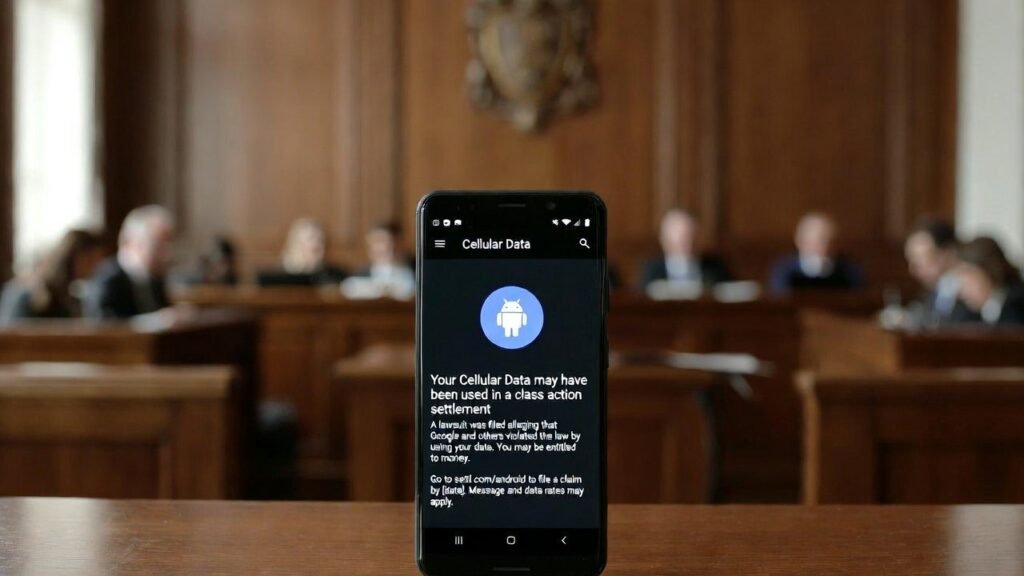
The legal battle surrounding Google’s background data collection has reached a critical turning point in 2026. For years, Android users have suspected that their devices were consuming cellular data even when sitting idle on a desk or tucked away in a pocket. This suspicion turned into a massive class-action lawsuit filed in California, alleging that Google designed the Android operating system to covertly transmit system logs, telemetry, and diagnostic data to its servers using users’ paid cellular plans. Unlike Wi-Fi transfers, which are generally free for the user, cellular data costs money, and the plaintiffs argued that Google was essentially “stealing” a resource paid for by the consumer to benefit its own advertising and engineering ecosystem.
As of early 2026, the case has moved from mere allegations to significant court rulings. A California jury recently found Google liable for these unauthorized transfers, marking a historic win for digital privacy. The lawsuit highlights a fundamental conflict in the modern tech era: the balance between a “free” operating system and the hidden costs associated with its maintenance. This guide provides an exhaustive look at every aspect of the lawsuit, from the technical mechanics of how the data was drained to the latest update on payouts and legal precedents that could reshape the future of the mobile industry.
What is the Google Android Cellular Data Lawsuit?
At its core, the google android cellular data lawsuit is a legal challenge against the way Google manages background processes on Android devices. The lawsuit, originally filed in August 2019, claims that Android phones send about 8.8 MB of data per day to Google’s servers even when the phone is not being used. While 9 MB might seem small, when multiplied by 14 million users in California alone over several years, it amounts to an astronomical amount of “stolen” bandwidth. The plaintiffs’ legal theory is based on the concept of “conversion”—which in legal terms means the unauthorized act of using someone else’s property (in this case, cellular data) for one’s own benefit.
The data being sent consists mainly of log files, network state indicators, and app activity reports. Experts in the case pointed out that while these files are necessary for Google to improve its services and target advertisements, they are not “time-sensitive.” This means Google could have easily programmed Android to wait until a Wi-Fi connection was available before sending these large batches of logs. Instead, the system was configured to use cellular data by default, effectively shifting the operational costs of Google’s research and development onto the monthly bills of unsuspecting consumers.
Table: Lawsuit Summary and Payout Estimates
| Feature | California Class (Current) | National Class (Pending) |
| Total Damages Awarded | $314.6 Million | Estimated $1.5 – $2.5 Billion |
| Estimated Users | 14 Million | ~120 Million |
| Individual Payout (Est.) | $10 – $20 | $5 – $15 |
| Trial/Verdict Date | July 2025 | Scheduled April 2026 |
| Primary Allegation | Unauthorized Cellular Data Use | Unauthorized Cellular Data Use |
Google Android Lawsuit California Verdict
The legal proceedings in California have been the primary focus of this controversy. In July 2025, a jury in the Santa Clara area returned a staggering verdict against the tech giant. Google was ordered to pay $314.6 million in damages to a class of approximately 14 million Android users residing in California. This decision was based on evidence showing that Google’s “passive” data collection practices were performed without meaningful user consent. The jury agreed with the argument that the terms of service provided by Google were too vague and did not explicitly state that users would be billed by their carriers for background system maintenance.
This California decision is considered a “bellwether” case, meaning it sets the tone for how similar lawsuits might be handled in other jurisdictions. The $314 million award is intended to compensate users for the “value” of the data consumed. Legal experts suggest that this could open the floodgates for more litigation. If a single state can secure such a high payout, the potential liability for Google across all 50 U.S. states and international markets could reach billions of dollars. Google has naturally announced its intention to appeal, but for now, the California verdict stands as a monumental rebuke of “hidden” data consumption.
Google Android Cellular Data Lawsuit Update 2026
Entering 2026, the google android cellular data lawsuit update centers on the appeals process and the expansion of the litigation to a national level. While the California class has won its initial round, a separate federal lawsuit representing Android users in the other 49 states is scheduled to go to trial in April 2026. This federal case is much larger in scope and could lead to a settlement or verdict that dwarfs the California award. Lawyers for the plaintiffs are using the evidence discovered in the California trial—such as the frequency of “passive pings” (nearly 389 times a day)—to push for a nationwide resolution.
For the average user, the most important update is the status of the claims process. Because Google is appealing the $314 million verdict, the money has not yet been distributed. The appellate court will review whether the jury’s interpretation of “property rights” regarding cellular data was legally sound. If the verdict is upheld, a third-party administrator will be appointed to manage the payout. Currently, users are advised to keep records of their Android device ownership dating back to 2016, as the “class period” for the lawsuit covers almost a decade of data usage.
Google Android Cellular Data Lawsuit Payout Details
Many people are asking about the google android cellular data lawsuit payout and how much they might actually receive. If the $314.6 million award is divided equally among 14 million California users, the individual payout would be relatively small—approximately $20 to $25 per person. However, legal fees and administrative costs usually take a significant portion (often up to 30%) of class-action settlements. Therefore, users might expect a check or digital payment ranging from $10 to $15. While this doesn’t seem like much, the lawsuit is more about the principle of transparency than life-changing money for individuals.
The payout process will likely involve a simple online form where users verify their identity and the Android devices they used during the class period (roughly August 2016 to the present). If the national lawsuit succeeds in April 2026, the total pool of money could grow to over $2 billion, which might increase individual payouts for users who can prove they had limited data plans that were impacted by Google’s background transfers. We expect the final distribution of funds to occur late in 2026 or early 2027, depending on how quickly the courts resolve Google’s appeals.
Google Android Upgrade Privacy Concerns in 2026
With the launch of Android 16 and subsequent updates in 2026, privacy has become the central theme of Google’s marketing, largely as a response to these lawsuits. However, the google android upgrade privacy concerns persist. Users are worried that even as Google adds new “Privacy Dashboards” and “Mic/Camera Indicators,” the deep-level system telemetry remains hidden. In 2026, tech critics are pointing out that “System Intelligence” features—which use AI to predict user behavior—require constant data exchanges with the cloud. Even if Google calls it “anonymous,” the lawsuit has proven that these exchanges still cost users money in data fees.
The concern is that the more “helpful” Android becomes (with AI integration), the more data it must send back and forth. In 2026, Google introduced “Advanced Protection” modes, but these are often opt-in. The lawsuit argues that privacy and data-saving should be “by default.” The 2026 updates have also faced scrutiny over “On-Device Scanning” for security, which some fear could be a back-door for broader data harvesting. As long as the operating system relies on background pings for its core functionality, the tension between feature-rich upgrades and data privacy will remain a major talking point for Android enthusiasts.
What is Google Messages on Android and Its Role?
A secondary but related topic is what is google messages on android. Google Messages is the default SMS and RCS (Rich Communication Services) app for most Android phones, including the Pixel line. While it offers modern features like end-to-end encryption and high-res photo sharing, it is also a heavy data consumer. Unlike traditional SMS, which uses the cellular signaling channel, RCS uses data. The lawsuit indirectly touches upon apps like Messages because they contribute to the constant “heartbeat” of data activity that keeps the phone connected to Google’s Jibe servers.
In 2026, Google Messages has evolved to include “Gemini” AI integration, allowing users to chat directly with an AI assistant within their texting app. This further increases the volume of background data being exchanged. Users are now more aware that every “typing indicator” or “read receipt” in Google Messages is a small packet of data being sent over their network. For those on limited data plans, the combined effect of system-level telemetry (the focus of the lawsuit) and high-data apps like Messages can lead to overage charges by the end of the month.
Google Android 16: New Features and Release
The release of Google Android 16 in mid-2025 (and its continued rollout in 2026) marked a significant shift in the OS architecture. Known internally as “Baklava,” Android 16 was released earlier than usual to align with new hardware launches. Key features include “Material 3 Expressive,” a design language that uses more blurs and animations, and “Live Updates” in the notification bar. However, the most relevant feature in the context of the lawsuit is the new “Background Data Manager,” which finally allows users to see exactly which system services are using cellular data versus Wi-Fi.
Android 16 also introduced “Desktop Windowing” for tablets and a “Linux Terminal” for developers, expanding the capabilities of the mobile OS to rival traditional computers. While these features are exciting, they also represent a higher complexity in data management. The “Embedded Photo Picker” now integrates cloud services like Google Photos directly into the system UI, making it easier to share files but also increasing the reliance on constant background syncing. For many, Android 16 is a double-edged sword: it offers the most control ever seen over privacy, but its underlying complexity requires more data than any previous version.
Google Android Pixel Layoffs and Restructuring
While the legal team is busy in court, the hardware division has faced internal turmoil. The google android pixel layoffs of 2025 and 2026 have seen hundreds of employees let go from the Platforms and Devices unit. Google CEO Sundar Pichai stated that these cuts were necessary to “rebalance” the company toward an AI-first future. This restructuring combined the Android and Pixel teams into a single cohesive unit, but at the cost of many veteran engineers and designers. These layoffs have sparked concerns that the quality of software updates or the speed of bug fixes might suffer in the long run.
The layoffs also reflect a shift in how Google views its hardware. Instead of just making a “phone,” Google is now focused on making an “AI vessel.” This means that the engineers who remain are focused on integrating Gemini AI into every layer of the Pixel experience. For users, the layoffs might mean fewer “experimental” features and a more streamlined, albeit AI-heavy, product lineup. The timing of the layoffs, coinciding with the massive lawsuit verdicts, has led some industry analysts to speculate that Google is cutting costs in anticipation of the multi-billion dollar legal payouts that may be coming.
Google Android Automotive Dashcam App
One of the most requested features for Android in cars has finally arrived: the google android automotive dashcam app. In late 2025, Google rolled out a system-level update for cars running Android Automotive (like Volvos and Polestars) that allows the vehicle’s built-in cameras to function as a dashcam. This app can record 4K footage of the road and automatically save clips if a collision is detected. It eliminates the need for third-party hardware and provides a “silent witness” that is always active while the car is running.
The dashcam app also integrates with Google Maps, allowing users to see their recorded routes with a speed overlay. However, in the spirit of the ongoing data lawsuit, Google has made sure to include strict controls for this app. Footage is stored locally on the car’s storage or a user-provided USB drive, rather than being automatically uploaded to the cloud. This “privacy-by-design” approach is a clear indication that the legal pressures from the cellular data lawsuit are influencing how Google develops new utility apps for the Android ecosystem.
Google Android XR Glasses and the Future
Google is officially back in the wearable game with google android xr glasses, confirmed for a 2026 launch. Developed in partnership with Samsung and stylish brands like Warby Parker, these glasses come in two versions: a screen-free “AI Assistant” model and a high-end “Display” model with AR overlays. These glasses run on a specialized version of Android called “Android XR,” which is designed to handle spatial computing and real-time AI interactions. The glasses use built-in cameras and microphones to allow users to “chat” with Gemini about what they are seeing in the real world.
The google android xr ecosystem is Google’s answer to the Meta Ray-Bans and the Apple Vision Pro. By leveraging the existing Android app library, Google hopes to provide a more “useful” AR experience from day one. However, the data concerns return here: these glasses require a constant, high-speed connection to the cloud to process AI requests. If the glasses are tethered to an Android phone, they will consume significant amounts of cellular data. Google is reportedly working on a “Data Saver” mode for XR to avoid a repeat of the legal issues that plagued the phone OS.
Google Android Decision: Regulatory Pressures
The recent google android decision by the U.S. Department of Justice (DOJ) and various courts has been a major blow to the company’s monopoly. In a landmark ruling, Google was ordered to open up its Play Store to third-party competitors and stop making its search engine the “default” on all Android devices. This means that in 2026, when you set up a new Android phone, you are presented with a “Choice Screen” for your browser, search engine, and even your app store. This is a massive shift in the power dynamic of the mobile industry.
These regulatory decisions are closely linked to the cellular data lawsuit. Both revolve around the idea that Google uses its dominant position to impose “unavoidable burdens” on users. By forcing Google to allow more competition, regulators hope to lower the hidden costs of the Android ecosystem. If users can switch to a more privacy-focused app store or a browser that doesn’t ping Google’s servers 300 times a day, the overall data consumption for the average person will decrease. 2026 is truly the year that the “Open” in Android is being tested by the law.
Como Pesquisar com uma Imagem no Google Android?
A very popular search query in 2026 is como pesquisar com uma imagem no google android (how to search with an image). This feature, known as “Circle to Search” or “Google Lens,” has become the primary way people interact with their phones. On modern Android devices, you can simply long-press the home button or navigation bar and circle anything on your screen to identify it. Whether it’s a pair of shoes in an Instagram post or a landmark in a photo, Google’s AI identifies it instantly and provides links to buy or learn more.
While this is incredibly convenient, it is also a data-heavy process. Every “Circle to Search” query sends a screenshot of your phone to Google’s servers. In the context of the lawsuit, users are now more aware that these “convenience features” are part of the broader data-exchange ecosystem. In 2026, Google added a “Local Processing” toggle for Lens, which allows the phone to identify common objects using the on-device NPU (Neural Processing Unit) without sending data to the cloud, a direct response to the growing demand for data privacy and efficiency.
Google Android News and Updates Today
Staying informed about google android news in 2026 requires keeping an eye on both the software blog and the courtroom. Google android updates today often include “Security Patches” that are delivered via the Play Store rather than a full system reboot. This “Modular Android” approach allows Google to fix vulnerabilities without waiting for carriers to approve a major update. Today’s news often focuses on the integration of “Gemini Nano”—Google’s smallest AI model—directly into mid-range phones, bringing features like “Magic Compose” and “Auto-Summary” to millions more users.
Another major headline in 2026 is the google android update deadline. Google has committed to 7 years of updates for its Pixel 8 and newer devices. This means that a phone bought in 2024 will still be getting official Android updates in 2031. This longevity is great for the environment and the consumer’s wallet, but it also means that the “background data” issues will persist for the life of the device. Users are encouraged to check their “Software Update” section regularly to ensure they have the latest “Data Transparency” features that have been mandated by recent court settlements.
Google Android Emulator for Developers
The google android emulator remains the most vital tool for developers in 2026. As Android expands to XR glasses, cars, and foldable tablets, the emulator allows programmers to test their apps on dozens of different “virtual” devices without buying the hardware. The 2026 version of the emulator is faster than ever, utilizing hardware acceleration to run Android 16 at 120Hz on a PC or Mac. It now includes “AI Simulation” modes, where developers can test how their apps react when the user interacts via a voice assistant or AR gestures.
For the purpose of the lawsuit, the emulator has also become a “crime scene” for forensic experts. Plaintiffs’ lawyers used emulators to prove that the Android OS makes thousands of connections to Google even when “Idle Mode” is enabled. Developers are now using the emulator’s “Network Inspector” to optimize their own apps, ensuring they aren’t also draining users’ cellular data. The emulator has evolved from a simple testing tool into a transparency dashboard that reveals the “hidden life” of the operating system.
Google Android 16 vs Android 15 Comparison
Table: Comparison of Android 15 vs Android 16
| Feature | Android 15 (2024) | Android 16 (2025/26) |
| Main Focus | Performance & Efficiency | AI Integration & Design |
| Data Control | Basic Privacy Dashboard | Background Data Manager |
| Design Language | Material You | Material 3 Expressive |
| New Hardware | Pixel 9 Series | Pixel 10 & Android XR |
| AI Assistant | Google Assistant / Gemini | Fully Integrated Gemini Nano |
| Desktop Mode | Experimental | Full Windowing Support |
This comparison shows that while Android 15 laid the groundwork for better performance, Android 16 is a massive leap in terms of features. The inclusion of the “Background Data Manager” in Android 16 is a direct result of the google android cellular data lawsuit, proving that legal pressure can lead to better software design for the end-user.
FAQs
1) What is the main allegation in the Google Android cellular data lawsuit?
The lawsuit alleges that Google programmed Android phones to passively send nearly 9MB of data per day to its servers over cellular networks, costing users money on their data plans without explicit consent.
2) Has anyone received a payout from the lawsuit yet?
No. Although a California jury awarded $314.6 million in 2025, Google is currently appealing the decision. Payouts are expected to begin late in 2026 or 2027 if the verdict is upheld.
3) How much money will I get from the Google Android lawsuit?
Estimated individual payouts for California residents are between $10 and $20. If a nationwide settlement is reached in 2026, that amount could change based on the final terms and number of claimants.
4) Which phones are affected by this lawsuit?
The lawsuit covers almost all Android devices (Samsung, Pixel, etc.) that have run Google’s version of the Android OS since August 2016.
5) Does Android 16 fix the background data issue?
Android 16 introduces a “Background Data Manager” that gives users more transparency and control, but the system still requires some background data for core security and functionality.
6) Is the lawsuit only in California?
Currently, the $314M verdict is for California residents. However, a separate federal class-action lawsuit for the rest of the U.S. is scheduled for trial in April 2026.
Conclusion
The google android cellular data lawsuit is more than just a legal battle over a few megabytes; it is a defining moment for the “Right to Data Transparency.” As we move through 2026, the ripple effects of the California verdict are being felt across the entire tech industry. Google is being forced to choose between its data-hungry business model and the legal requirements for user consent and property rights. For the millions of Android users, this case promises a future where their phone’s “idle” time is truly private and free.
Whether you are looking for the latest google android news, waiting for your payout, or exploring the features of Android 16, the message is clear: the days of hidden data consumption are coming to an end. We will continue to monitor the google android lawsuit update as the national trial begins in April. Until then, keep an eye on your data settings, support legal streaming and browsing, and stay tuned for the next evolution of the world’s most popular mobile operating system.
Disclaimer: The information provided in this article regarding the Google Android cellular data lawsuit is for general informational purposes only. While we strive for 100% detailing and accuracy, this content does not constitute legal or professional financial advice. Decisions regarding legal claims or payouts should be made after consulting with qualified legal counsel or official court administrators. We are not responsible for any inaccuracies in third-party reporting or changes in court rulings. Reliance on any information provided here is strictly at your own risk. All trademarks and brand names mentioned belong to their respective owners.
For More Information, visit magazinetribune
About the Author